Showing posts with label DCA. Show all posts

Tuesday, October 02, 2007

FOI statistics April to June 2007

The central government quarterly monitoring statistics for April-June 2007 have been published.
Executive Summary

Departments of State reported receiving 4,084 “non-routine” information requests during the second quarter of 2007 (Q2). Other monitored bodies received 3,904 requests. Across all monitored bodies, a total of 7,988 requests were received, of which 93 per cent had been processed at the time of monitoring. This includes 154 requests handled under the amended Environmental Information Regulations (EIRs) which came into force on 1 January 2005. [see Table 1]

The 7,988 requests across all monitored bodies received in the second quarter of 2007 is just a dozen more than the 7,976 received during the corresponding quarter of 2006. [see Table A]

During Q2 of 2007, 91 per cent of all monitored bodies’ requests (excluding those “on hold” or lapsed) were “in time”, in that they were processed within the statutory deadline* or were subject to a permitted deadline extension. This figure is the same as in both of the previous two quarters, but a little lower than in the corresponding quarter of 2006. [see Table 2 and Table B]

Of all “resolvable” requests received during Q2 of 2007 (i.e. requests where it was possible to make a substantive decision on whether to release the information being sought), 61 per cent were granted in full, a slightly smaller proportion than in the previous quarter. [see Table 3 and Table C].
Although the number of requests received by all monitored bodies was more or less the same as the corresponding period of 2006, the number of requests received by government departments actually fell by 5%.

Given the renewed emphasis that is being placed on vexatious requests, it would also be helpful if figures on the use of this provision could be included within Table 4 in future.

Read the full report.

Wednesday, June 20, 2007

Annual report on FOI in central government 2006

The Ministry of Justice has published the Annual Report on the FOI Act for 2006 which includes the statistics on the performance of central government in handling requests.

Foreword by Lord Falconer of Thoroton:
"It has been more than 2 years since the Freedom of Information Act came into force bringing about hugely significant reform that has made government and public authorities more open than ever before. At the core of Freedom of Information is the desire to bring about better government. From an increasingly beneficial impact on decision making to instilling a culture of openness and routine publication, a far greater amount of information is now more accessible than ever known before. The Act has had a positive effect on making the government and public authorities more accountable to the people they are there to serve."
Download the full report.

Friday, May 11, 2007

FOI statistics October to December 2006

The eight quarterly report providing FOI statistics for central government has been published by the DCA, covering the period October to December 2006:
Executive Summary

Departments of State reported receiving 4,500 “non-routine” information requests during the fourth quarter of 2006 (Q4). Other monitored bodies received 3,500 requests. These totals include 190 requests handled under the amended Environmental Information Regulations (EIRs).

During Q4 of 2006, 91 per cent of all monitored bodies’ requests (excluding those "on hold" or lapsed) were "in time", in that they were processed within the statutory deadline or were subject to a permitted deadline extension.

Of all "resolvable" requests received during Q4 of 2006, 59 per cent were granted in full.

In 2006, monitored bodies had a cumulative total of 1085 requests referred for Internal Review on the grounds that information was withheld. Of the 864 Internal Reviews with a known outcome at the time of monitoring, 77 per cent resulted in the request’s initial handling being upheld in full.
Interestingly the volume of requests to central government has increased:
"This overall total for Q4 of 2006 is 3.5 per cent greater than in the corresponding quarter last year (i.e. Q4 of 2005). The number of requests received by Departments of State increased by 13 per cent during this 12-month period, but the total received by other monitored bodies fell by 7 per cent."
On timelines, performance slipped slightly:
"Across all monitored bodies, 83 per cent of requests during Q4 of 2006 were sent a response within this standard deadline. Ninety-one per cent of requests received during Q4 were "in time", in that they either received a response within the standard deadline or were subject to a permitted deadline extension. Both of these measures, are slightly lower than in the preceding two quarters, but performance compares favourably with the corresponding quarter in the previous year.

It is notable that there have been small "dips" in timeliness performance in the final quarters of both the 2005 and 2006 calendar years. This suggests that there may be a seasonal factor at work here - possibly an effect of staff being on leave over the Christmas period."
The report also provides details of the duration of deadline extensions for the whole of 2006:
"the commonest period for which a deadline was extended [in the 2006 calendar year] was more than 40 days, accounting for 26 per cent of all extensions. However, almost a half (49 per cent) of completed, deadline-extended requests were subject to extensions of no more than 20 working days, and almost three quarters (74 per cent) were subject to extensions of not more than 40 days."
Read the full report.

Tuesday, March 06, 2007

Lord Falconer on FOI

Lord Falconer spoke about the importance of FOI and the government's proposed restrictions on access in a speech at the Canadian High Commission this morning:
"This Government took the unprecedented step, in the UK, of introducing the Freedom of Information Act.

It has been the single most significant act of any Government, in improving transparency, accessibility and accountability. It is the platform for building an improved relationship between the citizen and the state – in which the public can have a greater stake in how they are governed.

FOI was introduced to fundamentally alter the relationship between citizen and state. To re-establish trust in Government, to break down the cultural and institutional barriers that had historically put the public on the outside. A modern Liberal democracy is grounded on much more than the intermittent right to vote. It is must also be based on increased participation from the people. Enabling the public to see how and why the decisions impacting on them were made – is crucial in improving this relationship."

"We are currently consulting on new fee regulations proposals in order to ensure that the price we pay is not a reduction in the accessibility of Government. The FOI Act has been enormously successful - the vast majority have been for key information about issues- especially local issues – that have a real impact on peoples’ lives.

Many however are not so responsible. FOI was not introduced for finding out how many windows there are at Department for Education and Skills – or for how much Government spends on loo-roll. For instance we have subsidised the BBC’s research to the tune of about £1million since the Act came in."
Martin Rosenbaum has explained previously on his Open Secrets blog why the cost estimate of £1m for the BBC's use of the Act is exaggerated.

The full text of the Lord Falconer's speech is on the DCA website.

Friday, January 05, 2007

Statute Law database

The Statute Law Databse was released to the public on 20 December 2006. http://www.statutelaw.gov.uk/.

-DCA Press release

Read some of background about the SLD in these Guardian articles:

-At last, the price is right for access to our laws

-Access denied to the laws that govern us

With SLD you can:

- view amended legislation as it has changed over time
the green "A" icon will reveal the "attributes" of the legislation (e.g. start date, extent) and let you move between versions

- see how legislation will be affected by amendments not yet in force
the blue "P" icon indicates provisions, and versions of amended provisions, that have not yet been brought into force

- see how legislation has been amended for different jurisdictions
the yellow "C" icon denotes provisions that have "concurrent versions" (e.g. one for England and Wales and another for Scotland)

- navigate links between affecting and affected legislation
the purple arrow appears in affecting legislation against an amendment etc that has been applied and will take you to the affected legislation

- search the text of legislation for words and phrases
when you complete a text search, the red star icon will appear in the results list to show you which provisions match your search criteria

Wednesday, December 20, 2006

Freedom of Information statistics July to September 2006

The DCA yesterday released the Freedom of Information statistics for July to September 2006. The data shows a slight drop in the number of requests for all monitored bodies (5%) compared to last year, but broadly I would say this indicates demand for FOI holding up. It is also worth noting that "the number of requests received by Departments of State increased by 8 per cent during this 12-month period, but the total received by other monitored bodies fell by 17 per cent." (see page 8) The DCA seem to be using the stats to make a point about the rising burden on depts of state (compared to the other monitored bodies e.g. agencies), to help the case for the new fees regs proposals (Martin at open secrets has posted his comments on this and has noted the the the increase to the Depts totals was mainly due to a doubling of requests to the Home Office, rather than any overall trend)

On a positive note there has been quite a big improvement in the reduction in use of permitted extensions beyond 20 working days to consider: 2006: 676 during Q1, 605 during Q2 and 473 during Q3). The DCA was pressed to monitor and add this data to the reports and it may be that the monitoring process has encouraged fairer use of the permitted extension and only when necessary. Though it is worth noting that 20% of the extensions during 2006 were for 40 days or more. In the 2005-2006 ICO annual report the Commissioner notes: "There are particular problems where time is taken to consider public interest considerations or carry out an internal review. A maximum of two months for each stage should be quite long enough in most cases". I would suggest there is still room for improvement.

Depts of State seem to faring worse at the ICO: Percentage of appeals where initial handling was upheld in full: Depts of state: 67% other moniored bodies: 91%

Executive summary
Departments of State reported receiving slightly over 4,100 “non-routine” information requests during the third quarter of 2006 (Q3). Other monitored bodies received around 3,500 requests. These totals include 150 requests handled under the amended Environmental Information Regulations (EIRs).

During Q3 of 2006, 93 per cent of all monitored bodies’ requests (excluding those “on hold” or lapsed) were “in time”, in that they were processed within the statutory deadline or were subject to a permitted deadline extension.

Of all “resolvable” requests received during Q3 of 2006, 61 per cent were granted in full. Of the remaining requests, 14 per cent of the total were withheld in part, 19 per cent were withheld in full, and the remaining 6 per cent had not yet received a substantive response.

In the first, second and third quarters of 2006, monitored bodies had a cumulative total of 853 requests referred for Internal Review. Of the 629 Internal Reviews with a known outcome at the time of monitoring, 75 per cent resulted in the request’s initial handling being upheld in full.


Full report

Martin at Open Secrets has also added some comment about the stats.

Wednesday, October 11, 2006

Freedom of Information statistics April to June 2006

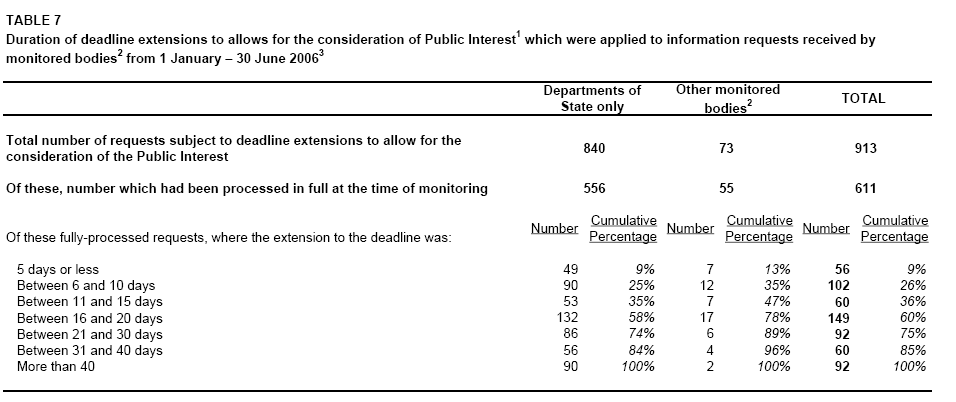
The DCA have published the latest statistics for Depts of State and "other monitored bodies". The stats show little change in volumes and performance and show a steady state. The way the figures had not been more explicit in terms of highlighting requests being extended beyond the 20 working day limit has been critcised in the past: table seven now sets out separately the details of requests subject to a "permitted extension". Requests subject to the permitted extension are catgeorised as "in time" in the stats in table B. Across all monitored bodies, there were 1,281 requests (7 per cent of the total received) which were subject to permitted deadline extensions during the first two quarters of 2006 (676 during Q1, 605 during Q2). (full data is available for 913 of these 1,281 requests). In 2005 3587 requests were given a "permitted extension" - the figures for 2006 show no projected increase or decrease for 2006. I presume that this extra data has been added partly in response to the CA Select Committee's comments earlier this year on these issues. Also, as Alasdair Roberts has pointed out in the past there is a need to try match the data from requests given the extended deadline to data relating to their treatment in the clearing house, if they have been passed there.


Executive summary
Departments of State reported receiving just under 4,300 “non-routine” information requests during the second quarter of 2006 (Q2). Other monitored bodies received just under 3,700 requests. This totals include 139 requests handled under the Environmental Information Regulations (EIRs).

During Q2 of 2006, 92 per cent of all monitored bodies’ requests (excluding those “on hold” or lapsed) were “in time”, in that they were processed within the statutory deadline or were subject to a permitted deadline extension.

Of all “resolvable” requests received during Q2 of 2006, 61 per cent were granted in full. Of the remaining requests, 11 per cent of the total were withheld in part, 17 per cent were withheld in full, and the remaining 7 per cent had not yet received a substantive response.

In the first and second quarters of 2006, monitored bodies had a cumulative total of 541 requests referred for Internal Review. Of the 342 Internal Reviews with a known outcome at the time of monitoring, 75 per cent resulted in the request’s initial handling being upheld in full.

Friday, September 15, 2006

Government - data sharing

The DCA have recently published their vision for data sharing, previously trailed in The Guardian

HM Government: information sharing vision statement [PDF 400kb, 11 pages]
Government is committed to more information sharing between public sector organisations and service providers. This statement sets out our vision for better, more customer-focused services supported by greater information sharing which will protect and support individuals and society as a whole. [13 September 2006]


Read Government Computing article

Wednesday, September 06, 2006

Department of Constitutional Affairs' Information Rights Journal

The DCA have published issues 3 & 4 of their Information Rights Journal

Articles of interest in the Journal

-The section 16 duty of advice and assistance
-Records management: FOI and beyond (Author: Natalie Ceeney, Chief Executive, The National Archives)
-Article: Information rights in local government and future challenges

Wednesday, July 26, 2006

Review of the implementation of the Human Rights Act

The Lord Chancellor published a review on the implementation of the Human Rights Act on 25 July 2006. Contents:

Executive Summary
Introduction by the Lord Chancellor
Background
Impact on development of substantive law
Direct impact on policy formulation and decision making
Myths and misperceptions
Analysis of overall effect
Possible solutions
Annex: The Convention rights

Full report [PDF 422kb, 52 pages]
Executive Summary and Introduction by the Lord Chancellor [PDF 87kb, 7 pages]

Sunday, July 23, 2006

DCA publish information about the inquest into the death of Diana, Princess of Wales

The DCA disclosure log has been updated with details a response to an FOI request about the inquest into the death of Diana, Princess of Wales:

Title of FOI release: The inquest into the death of Diana, Princess of Wales
Date released to the requester: 21 July 2006
Date published on website: 21 July 2006

Information released:
Documents relating to the coroner's inquest into the death of Diana, Princess of Wales.

Response to freedom of information request [PDF 28kb, 3 pages]
Response to the Freedom of Information Request for documents on the departmental files relating to the reasons why the Coroner of the Queen's Household is holding the inquest and the delay in holding the inquest into the death of Diana, Princess of Wales.

Home office circular - part one [PDF 504kb, 8 pages]
Home office circular - part two [PDF 477kb, 8 pages

Friday, July 14, 2006

Information Rights User Group

I've flagged up the User Group established by DCA before, it has now met for the first time, there were concerns about the process of its setting up being rather secret and not that transparent.

We have established a panel of users to act as a sounding-board on how the Act is working in practice, and to inform the Government about their experiences of the Act.

The group will be provided with information on the operation of the Act and will be invited to provide feedback to us, which will help us ensure that FOI meets users’ needs properly and effectively. Overseas experience has demonstrated that sustained and committed effort devoted to fostering an active and widespread FOI constituency amongst users helps to promote the long-term success of the Act.

The group is chaired by Baroness Ashton of Upholland, and the members of the group are:

Steve Bailey JISC, University of Bristol
Jane Bacot-Kilpatrick Hampshire and Isle of Wight Strategic Health Authority
Paul Bettison Leader Bracknell Forest Borough Council
Peter Bottomley, MP
Judith Cullen Head of Environmental Information Unit, DEFRA
Maurice Frankel Campaign for Freedom of Information
Professor Robert Hazell University College London Constitution Unit
John Hipwood Chairman of the Press Lobby
Rosemary Jay Pinsent Masons
Anthony Kenny Intellect UK
Lord Lester of Herne Hill
Adrian Pollitt Head of the Office of Strategic Health Authorities
Ian Readhead Deputy Chief Constable, Hampshire Constabulary
Bob Satchwell Society of Editors
Richard Thomas (observer) Information Commissioner


The first meeting minutes are not exactly informative......

Minutes of the first meeting - 8 June 2006 (PDF)

See my previous posts : Nov 05 and Aprtil 06

Also see Heather Brooke's posts: With friends like these…? and Selection secrecy for FOI users group

Thursday, June 29, 2006

Freedom of Information statistics January to March 2006

Now live on the DCA FOI site: The fifth quarterly report providing statistics on implementation of the Act across central government covers January to March 2006. The trends are very much in line with previous stats, the figure of quoted by the DCA of 90% of requests being responded to "in time" (i.e. meeting deadline or with permitted extension) needs to compared with 83% being within the 20 working day deadline. The DCA tend to use the 90% rather than the 83% as the headline figure. We also don't have any data about the length of these extended deadlines. (permitted under the FOIA to consider the public interest S10(3))

Monday, May 22, 2006

DCA publish first Freedom of Information Annual Report

The Freedom of Information Annual Report 2005: Operation of the FOI Act in central government [PDF 500kb, 48 pages] was laid before Parliament today.

Sunday, May 14, 2006

Meetings between DCA Ministers and outside interest groups

This document has been posted on the DCA disclosure log after an FOI request, there doesn't appear to be anything related to FOI but the information is generally interesting in terms of enabling slightly more transparency in these areas (this only includes "formal" meetings though I presume.) These listings could also be targeted for further requests etc.

Wednesday, April 12, 2006

Selection secrecy for FOI users group

Heather at YRTK makes some valid comment about the DCA User group and has managed to finally found out the membership via an FOI request.

I made a posting on the subject November of last year.

Thursday, April 06, 2006

Freedom of Information Statistics

Freedom of Information statistics for October to December 2005 are now available from the DCA covering all Central Depts and other centrally monitored bodies.

Executive summary
-Departments of State reported receiving just under 4,000 "non-routine" information requests during the fourth quarter of 2005 (Q4). Other monitored bodies received around 3,750 requests. Across all monitored bodies, over 7,700 requests were received, of which 90 per cent had been processed at the time of monitoring.

-The Q4 total of 7,700 requests across all monitored bodies compares to previous quarterly totals of 13,600 during the first quarter of 2005 (Q1), 8,400 during Q2 and 8,100 during Q3 (Note 8). These figures suggest that there was a marked initial peak in request volumes during the first quarter of the FoI Act's implementation.

-During Q4, 89 per cent of all monitored bodies' requests (excluding those "on hold" or lapsed) were "in time", in that they were processed within the statutory deadline or were subject to a permitted deadline extension. This represents an increase on the equivalent figures from Q1 (83 per cent) and Q2 (88 per cent), but a very small decrease from Q3 (90 per cent).

-Of all "resolvable" requests received during Q4 (i.e. requests where it was possible to make a substantive decision on whether to release the information being sought), 67 per cent were granted in full, the same as during Q3. Of the remaining Q4 requests, 10 per cent of the total were withheld in part, 16 per cent were withheld in full, and the remaining 7 per cent had not yet received a substantive response.

-Across all four quarters combined, monitored bodies had a cumulative total of 1,267 requests referred for Internal Review on the grounds that information was withheld. Of the 1,057 Internal Reviews with a known outcome at the time of monitoring, 77 per cent resulted in the request's initial handling being upheld in full.

Download the full report [PDF 332kb, 36pages]

Wednesday, March 15, 2006

Academy Schools and FOI

A reader of the blog has sent me a copy of a letter he received from his MP about Academy schools not being covered by the FOIA.

The letter included a response from the DCA Minister Baroness Ashdown (Read the letter from Baroness Ashton) that suggests that Academy Schools cannot be added by ammending Schedule 1 using the powers under S4(1)of the FOIA as academies do not satisfy this condition of S4:

3) The second condition is-

(a) in the case of a body, that the body is wholly or partly constituted by appointment made by the Crown, by a Minister of the Crown, by a government department or by the National Assembly for Wales, or
(b) in the case of an office, that appointments to the office are made by the Crown, by a Minister of the Crown, by a government department or by the National Assembly for Wales.


As this issue has not come up before we cannot be sure what is meant by "partly constituted by appointment" but according to the DFES website the running of these schools certainly has direct involvement with officials from the DFES which could satify the "by a governmeny department" part:

"Once the Secretary of State has given approval for an Academy, an Academy Trust is formed which will be responsible for the building and running of the Academy and has control over the land and other assets. The Trust is a charitable company. Members of this Company (Trust) include the sponsor, the chair of the governing body, other members and a representative of the Secretary of State. The Members of the Trust have limited liability up to L10 in the event of financial difficulty. They delegate the management of the school to the governors (Directors)."
(DFES)

The letter does also state they could be added under section 5 as a private organisation providing functions of a public nature. (None have been added this way so far). No timetable is offered for this though. It should also be added that the Lord Chancellor did make reference to the fact they were considering extending coverage in his speech to the British Academy back in February:

"We are looking right now at how exactly we will do this. The sort of private bodies we're likely to extend to are privately run prisons and school academies - which should be subject to the same principles of openness and transparency that applies to the thousands of other public authorities covered by FOI. But we will ensure that - where we extend the scope - it does not have a disproportionate impact on the ability of those bodies to carry out their functions. We need to get the balance right."


Thanks to David for sending this.

Wednesday, February 22, 2006

DCA's Information Rights Journal

The 2nd issue the Information Rights Journal prodcued by the DCA is now available.

Download issue 2 (PDF)

Contents:

Editorial
In the News
Future events
Recent Developments
Simplifying Data Protection
Freedom of Information in the US
Recent articles
ICO decisions
IT decisions
Other jurisdictions

Tuesday, January 24, 2006

DCA mailing list

The DCA are offering an email subscription service for those wanting updates on information rights:

"If you want to be kept informed about our work on information rights, please subscribe to our information rights updates mailing list. We will use the mailing list to let you know when this site is updated, and pass on our ‘latest news’ about Freedom of Information and Data Protection. Your details will not be used for any other purposes without your express consent."